
Diwali Puja Samagri List 2026: Complete Lakshmi Ganesh Puja Items, Muhurat, Vidhi & Checklist

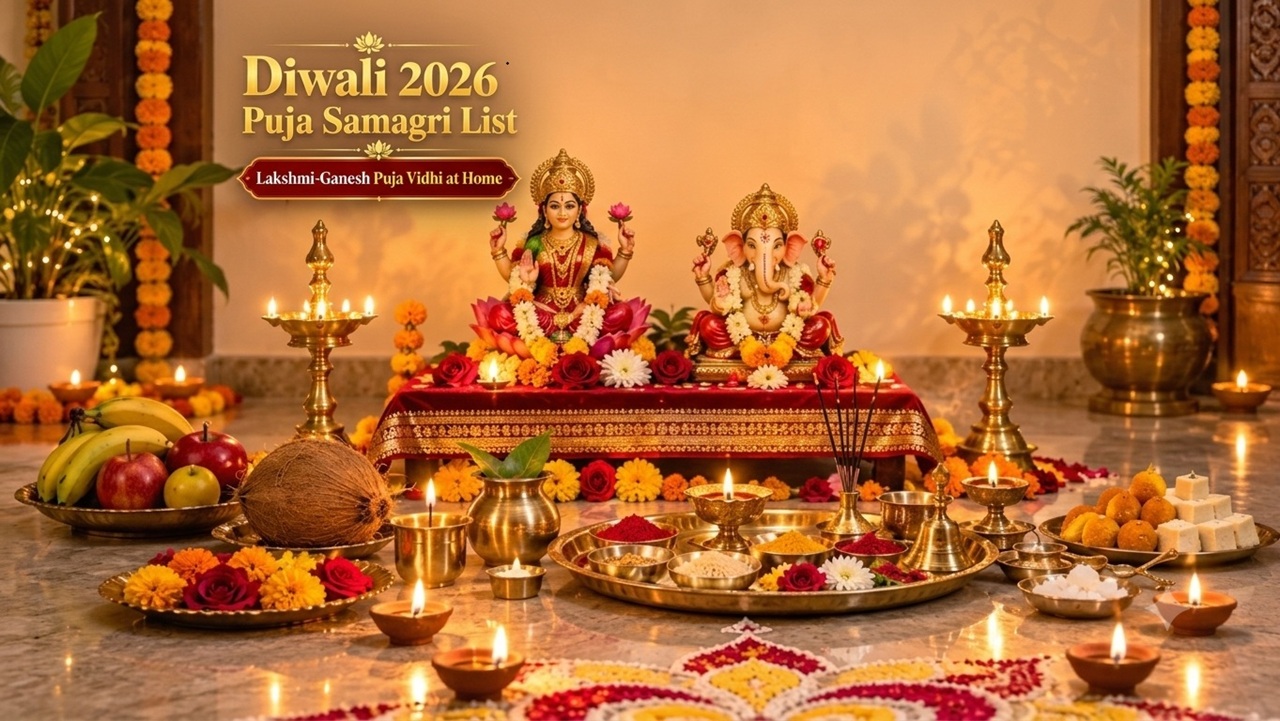
Diwali is one of the most important Hindu festivals of the year, and Lakshmi Ganesh Puja performed on Diwali evening is at the heart of the celebration in many homes and businesses.
Families clean and decorate their homes, light diyas, prepare sweets and offerings, and worship Goddess Lakshmi and Lord Ganesha for prosperity, wisdom, auspicious beginnings, and wellbeing.
In 2026, Diwali and Lakshmi Puja will be observed on Sunday, November 8.
If you are preparing for Lakshmi Puja, this guide brings together the complete Diwali Puja Samagri List 2026, traditional special-purpose samagri, fresh items that should be bought separately, basic puja steps, and important Lakshmi Puja timings.
What Is the Complete Diwali Puja Samagri List for Lakshmi Ganesh Puja in 2026?
The main Diwali Puja Samagri includes Haldi, Roli, Akshat, Chandan, Gangajal, Supari, Kapoor, Agarbatti, Dhoop, ghee wicks, Janeu, red cloth, Lakshmi-Ganesh coins, Sarvoshadhi, Saptamrittika, flowers, fruits, sweets, diyas and Lakshmi-Ganesha idols.
The essential Diwali Puja Samagri commonly includes:
- Haldi
- Kumkum or Roli
- Akshat
- Chandan
- Rakta Chandan
- Ashtagandha
- Gangajal
- Supari
- Janeu
- Laung
- Elaichi
- Kapoor
- Agarbatti
- Dhoop
- Ghee wicks
- Diya
- Red cloth
- Puja attar
- Guggul or Sambrani
- Sarvoshadhi
- Saptamrittika
- Lakshmi-Ganesh coins
- Flowers
- Fruits
- Sweets or Naivedhya
- Lakshmi and Ganesha idols or images
Some families also use a Kalash, fresh leaves, special herbs, account books, new pens, multiple diyas, and other items according to their tradition.
Which Essential Lakshmi Ganesh Puja Samagri Is Needed for Diwali?
Haldi
Haldi or turmeric is used during worship as an auspicious puja ingredient.
Kumkum or Roli
Roli or Kumkum is used for tilak and offerings to the deities.
Akshat
Akshat refers to whole, unbroken rice grains traditionally offered during Hindu puja.
Chandan
Chandan or sandalwood powder is commonly used for tilak and devotional offerings.
Rakta Chandan
Rakta Chandan or red sandalwood is another traditional puja ingredient used in several forms of worship.
Ashtagandha
Ashtagandha is an aromatic sacred mixture traditionally used for tilak and puja.
Gangajal
Gangajal is commonly used for purification of the puja space, samagri, and worship area.
Supari
Betel nuts are used symbolically in several Hindu rituals and are commonly included in Lakshmi Puja samagri.
Janeu
Sacred thread or Janeu may be offered during deity worship according to the puja procedure being followed.
Laung and Elaichi
Cloves and cardamom are commonly used among aromatic or offering ingredients during traditional puja.
What Is Sarvoshadhi and Why Is It Used in Diwali Lakshmi Puja?
Sarvoshadhi is a traditional combination of sacred herbs such as Mura, Jatamasi, Bach, Kushtha, Shaileya, Haradi, Daru-Haradi, Soonthi, Champak and Musta.
It forms part of the specialised samagri associated with elaborate Lakshmi Puja rather than everyday worship.
Because the individual herbs can be difficult to source separately, a prepared Sarvoshadhi mixture makes it considerably easier for devotees to keep this traditional element of the puja ready.
What Is Saptamrittika in Diwali Puja and Why Is It Included?
Saptamrittika literally refers to sacred soil associated traditionally with seven different places.
Traditional Lakshmi Puja references describe soil associated with places such as:
- Cow shelter
- Ant hill
- River confluence
- Horse stable
- Elephant stable
- Low-lying land
- Royal or significant ceremonial place
Saptamrittika forms part of more elaborate traditional Lakshmi Puja preparations.
For households that wish to follow a detailed puja method, having prepared Saptamrittika available avoids the impractical task of sourcing seven types of soil individually.
Which Diwali Puja Items Are Needed for Deep Prajwalan and Aarti?
Lighting lamps is inseparable from the celebration of Deepavali.
Keep the following items ready:
- Earthen diyas
- Ghee or oil
- Ghee wicks or cotton wicks
- Kapoor
- Matchbox or lighter
- Agarbatti
- Dhoop
- Guggul or Sambrani
Traditionally, multiple lamps are lit around the home after the main puja.
The number and placement of diyas can vary according to family practice.
What Cloth or Vastra Is Needed for Lakshmi Ganesh Puja on Diwali?
Traditional Lakshmi Puja preparations may use separate cloths for the deities and puja setup.
A red cloth is widely associated with Goddess Lakshmi and auspicious worship.
Some traditions also use yellow, white or additional cloth according to the deity and individual puja procedure.
The cloth may be placed beneath the deity, used as an offering, or used to prepare the puja area.
What Fresh Items Should Be Bought Separately for Diwali Lakshmi Puja?
Several Diwali offerings are fresh or perishable and are best purchased close to the puja.
These may include:
- Fresh flowers
- Flower garlands
- Fruits
- Sweets
- Sugarcane
- Paan
- Tulsi leaves
- Bilva leaves
- Durva grass
- Coconut
- Milk
- Ghee
- Fresh Prasad
- Naivedhya
Are Lakshmi and Ganesha Idols Required for Diwali Pooja?
Lakshmi and Ganesha are traditionally worshipped together on Diwali.
Many families purchase new Lakshmi-Ganesh murtis for the occasion, while others worship existing household deities or images according to their family tradition.
Why Are Lakshmi-Ganesh Coins Used During Diwali Puja?
Coins depicting Goddess Lakshmi and Lord Ganesha are commonly associated with Diwali and prosperity rituals.
They may be placed in the pooja thali, offered during Lakshmi Puja, or kept later in the home, locker, or place of business according to family custom.
Lakshmi-Ganesh coins also provide a symbolic representation of prosperity and auspicious beginnings.
Is Bahi-Khata or Account Book Puja Performed on Diwali?
Yes. Traders, business owners, and many families traditionally worship their Bahi-Khata, account books, or financial records during Diwali.
Modern businesses may also symbolically worship:
- Account books
- Business registers
- Ledgers
- Pens
- Computers
- Business documents
- Cash boxes or lockers
A new pen and traditional account book may, therefore, be arranged separately for those observing Chopda Pooja or Bahi-Khata Pooja.
What Is Panch Pallav and Is It Required for Lakshmi Puja?
Traditional detailed Lakshmi Pooja lists may include Pancha Pallav, meaning leaves or twigs from five sacred trees.
The list commonly mentioned includes:
- Mango
- Palash
- Banyan
- Peepal
- Bakul
These items form part of more elaborate puja traditions and may not be easily available in every household or city.
Where particular traditional items cannot be sourced, devotees should follow their family’s puja practice or the guidance of their priest.
What Is the Diwali Lakshmi Puja Vidhi Step by Step?
The precise Lakshmi Puja Vidhi differs across regions and families, but the celebration generally follows these broad steps.
1. Clean and Prepare the Pooja Area
- Clean the home and pooja space thoroughly before beginning the evening worship.
- Set up a clean chowki or altar and cover it with an appropriate cloth.
2. Install Lakshmi and Ganesha for Puja
- Place the idols or images of Goddess Lakshmi and Lord Ganesha on the prepared puja platform.
- Depending on family tradition, Goddess Saraswati may also be worshipped.
3. Purify the Pooja Space
- Use Gangajal to ritually purify the worship area and pooja materials.
4. Light the Diya
- Light the main diya using ghee or oil and keep it safely near the puja area.
5. Perform Ganesh Puja
- Lord Ganesha is traditionally worshipped before beginning the main Lakshmi Puja.
- Offer roli, akshat, flowers and other customary samagri.
6. Perform Goddess Lakshmi Pooja
- Offer haldi, kumkum, chandan, akshat, flowers, fragrance, and Naivedhya to Goddess Lakshmi.
- Specialised samagri such as Sarvoshadhi and Saptamrittika may also be used according to the pooja procedure being followed.
7. Worship Wealth and Business Symbols
- Account books, coins, cash boxes, lockers or business ledgers may be worshipped according to family or commercial tradition.
8. Offer Dhoop and Fragrance
- Light agarbatti and dhoop and offer fragrance during the worship.
9. Offer Naivedhya
- Offer sweets, fruits, and other prepared Prasad.
10. Perform Lakshmi-Ganesh Aarti
- Complete the worship with Aarti and distribute Prasad among family members.
11. Light Diyas Around the Home
After Lakshmi Puja, lamps are traditionally placed around the home to mark Deepavali.
What Is the Diwali 2026 Lakshmi Puja Muhurat in New Delhi?
For New Delhi, Lakshmi Puja will be performed on Sunday, November 8, 2026.
The important timings are:
- Lakshmi Pooja Muhurat: 5:54 PM to 7:50 PM
- Duration: 1 hour 56 minutes
- Pradosh Kaal: 5:31 PM to 8:09 PM
- Vrishabha Kaal: 5:54 PM to 7:50 PM
- Amavasya Tithi begins: 11:27 AM on November 8
- Amavasya Tithi ends: 12:31 PM on November 9
Puja Muhurat varies by location, so devotees outside Delhi should check the Lakshmi Puja timing for their own city.
Which Diwali Puja Samagri Should You Keep Ready Before Lakshmi Puja?
The easiest way to avoid last-minute shopping is to organise all shelf-stable items beforehand.
Keep ready:
- Haldi
- Kumkum/Roli
- Akshat
- Kapoor
- Agarbatti
- Dhoop
- Ghee wicks
- Matchbox
- Red cloth
- Supari
- Gangajal
- Chandan
- Rakta Chandan
- Ashtagandha
- Janeu
- Laung
- Elaichi
- Guggul
- Puja Attar
- Sarvoshadhi
- Saptamrittika
- Lakshmi-Ganesh coins
Fresh flowers, fruits, sweets, leaves, Prasad, diyas, and deity idols can then be arranged according to household requirements.
Can I Buy a Ready-Made Diwali Puja Samagri Kit Online?
Yes. A well-planned Diwali Pooja Kit can save the effort of sourcing dozens of small ritual ingredients separately.
The Divine Samagri Diwali Puja Potli brings together key shelf-stable Lakshmi-Ganesh Puja ingredients, including some specialised traditional materials that may otherwise be difficult to find individually.
Divine Samagri Diwali Puja Potli includes:
- Haldi powder – 30 gm
- Kumkum / Roli – 20 gm
- Akshat – 200 gm
- Kapoor – 15 gm
- Agarbatti – 1 packet
- Dhoop cones – 2 pieces
- Cotton wicks – 5 pieces
- Red cloth – 2 pieces
- Supari – 5 pieces
- Lakshmi-Ganesh coin – 1 piece
- Gangajal – 50 ml
- Chandan powder – 10 gm
- Rakta Chandan – 5 gm
- Janeu – 2 pieces
- Laung – 5 pieces
- Small / Green Elaichi – 5 pieces
- Guggul / Sambrani – 10 gm
- Puja Attar – 2 ml
- Sarvoshadhi – 10 gm
- Saptamrittika – 20 gm
- Abeer – 50 gm
- Sabut Dhaniya – 20 gm
- Jau – 50 gm
- Gulab Jal – 1 small bottle
- Haldi ganth – 5 pieces
- Yellow cloth – 1 piece
- Kamalgatta – 5 pieces
- Kaudi – 5 pieces
- Gomati Chakra – 2 pieces
- Diya – 2 pieces
- Sindoor – 1 piece
- Mauli – 1 piece
- Lakshmi Charan – 1 pair
Fresh flowers, fruits, sweets, Lakshmi-Ganesh idols, puja utensils, and other personal or household items should be arranged separately.
Frequently Asked Questions About Diwali Puja Samagri 2026
When is Diwali in 2026?
Diwali and Lakshmi Puja will be observed on Sunday, November 8, 2026.
What is the Lakshmi Puja Muhurat in Delhi on Diwali 2026?
For New Delhi, the Lakshmi Puja Muhurat is 5:54 PM to 7:50 PM on November 8, 2026.
What are the most important items for Diwali Lakshmi Puja?
Common essentials include roli, haldi, akshat, chandan, Gangajal, diya, wicks, kapoor, incense, flowers, Prasad, supari and sacred cloth.
What is Sarvoshadhi used for?
Sarvoshadhi is a traditional combination of herbs used as part of detailed Lakshmi Puja rituals.
What is Saptamrittika?
Saptamrittika is a traditional mixture associated with sacred soil from seven places and appears in elaborate Lakshmi Puja samagri lists.
Are Lakshmi-Ganesh idols included in every Diwali Pooja Kit?
No. Many people prefer selecting their own idols according to size, material and family tradition, so these may be sold or purchased separately.
How many diyas are required for Diwali Puja?
There is no single universal number followed by every household. Traditional detailed lists may call for several large and small earthen lamps, while families also follow their own customs.
Prepare Your Diwali Pooja Samagri Before the Muhurat Begins
Diwali evening is not the ideal time to discover that the Kapoor is finished, the Akshat is missing, or a specialised pooja ingredient was never purchased.
Preparing the essential samagri beforehand makes the Lakshmi-Ganesh Puja more organised and allows the family to focus on the worship itself.
The Divine Samagri Diwali Puja Potli brings together everyday puja essentials as well as traditional ingredients such as Rakta Chandan, Ashtagandha, Guggul, Sarvoshadhi and Saptamrittika in one organised pack.
Arrange your fresh flowers, sweets, fruits, diyas, and deities separately — and keep the essential puja samagri ready before the auspicious Lakshmi Puja Muhurat begins.